
Landscaping in Auburn, CA: How to Create a Beautiful Yard That Thrives in the Foothills
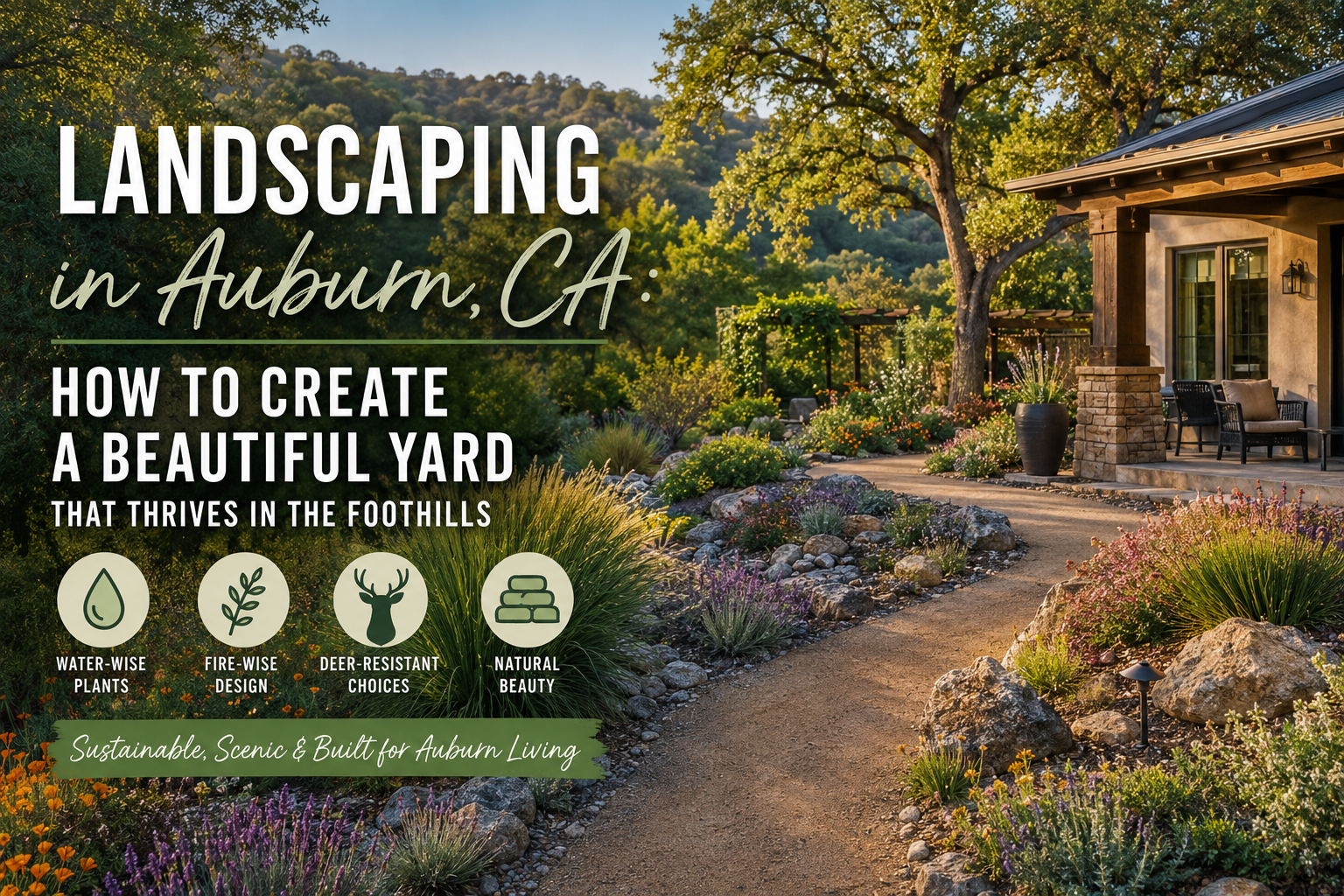
Auburn sits at a sweet spot — roughly 1,200 feet in the Sierra Nevada foothills, where the valley heat softens just enough to grow an impressive range of plants, but where summer drought and clay-heavy soils still demand thoughtful planning. Whether you're starting from scratch on a new build or refreshing an overgrown lot, here's what you need to know about landscaping in Auburn.
Know Your Climate Before You Plant
Auburn falls in USDA Hardiness Zone 9b, with average winter lows around 25–30°F and summers that regularly push past 100°F. The region gets most of its precipitation between November and April — then almost nothing for five or six dry months. That Mediterranean-style rainfall pattern is the single most important factor shaping every landscaping decision you'll make.
The good news: some of the world's most beautiful plants are adapted to exactly this kind of climate. The bad news: many of the plants sold at big-box garden centers are not.
Embrace Water-Wise Landscaping
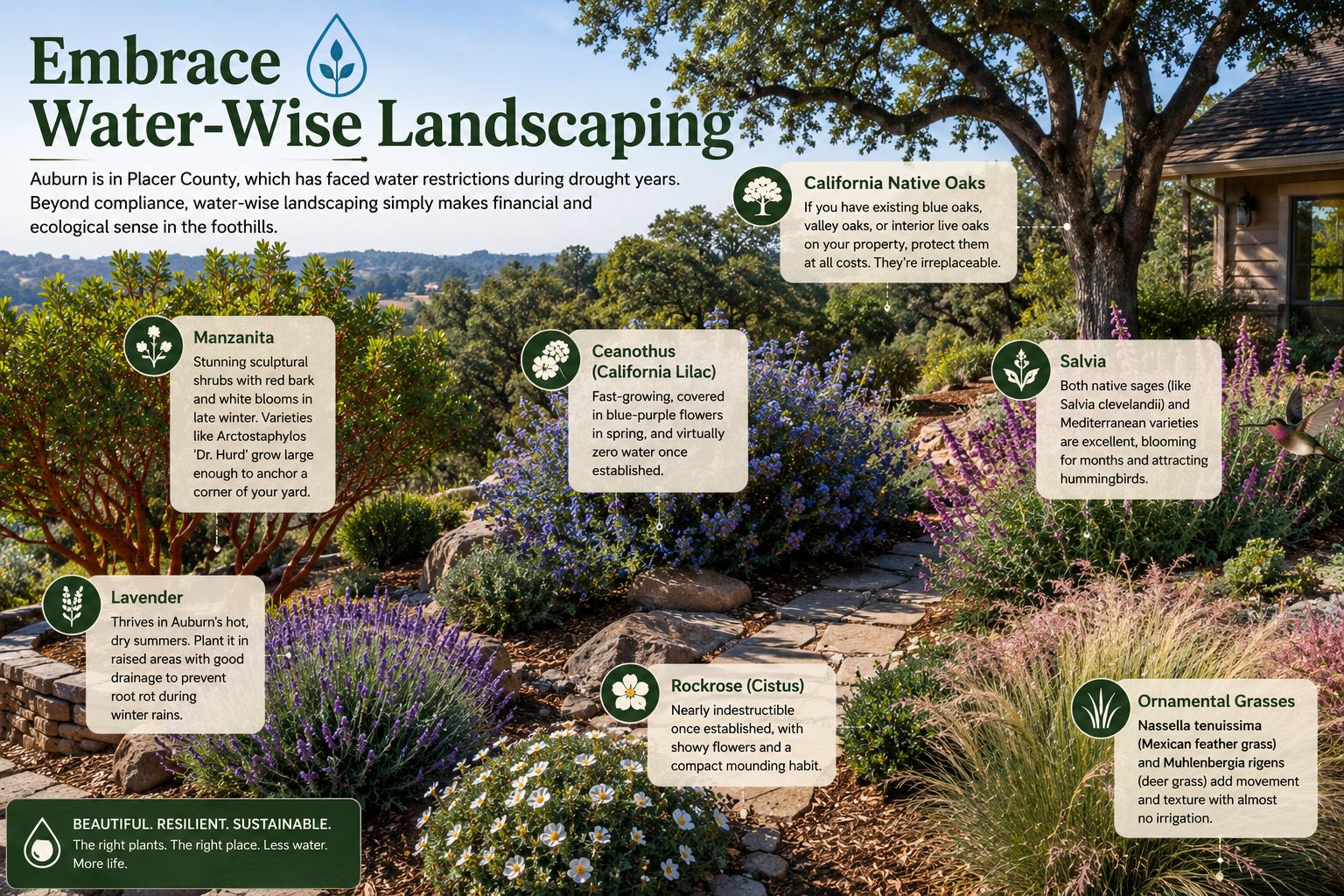
Auburn is in Placer County, which has faced water restrictions during drought years. Beyond compliance, water-wise landscaping simply makes financial and ecological sense in the foothills.
Top drought-tolerant plants that thrive in Auburn:
California native oaks — If you have existing blue oaks, valley oaks, or interior live oaks on your property, protect them at all costs. They're irreplaceable.
Manzanita — Stunning sculptural shrubs with red bark and white blooms in late winter. Varieties like Arctostaphylos 'Dr. Hurd' grow large enough to anchor a corner of your yard.
Ceanothus (California Lilac) — Fast-growing, covered in blue-purple flowers in spring, and virtually zero water once established.
Salvia — Both native sages (like Salvia clevelandii) and Mediterranean varieties are excellent, blooming for months and attracting hummingbirds.
Lavender — Thrives in Auburn's hot, dry summers. Plant it in raised areas with good drainage to prevent root rot during winter rains.
Rockrose (Cistus) — Nearly indestructible once established, with showy flowers and a compact mounding habit.
Ornamental grasses — Nassella tenuissima (Mexican feather grass) and Muhlenbergia rigens (deer grass) add movement and texture with almost no irrigation.
Deal With Auburn's Challenging Soil
Much of Auburn sits on decomposed granite, clay, or rocky foothill soils — none of which are easy to work with right out of the ground. Before planting, get a simple soil test (UC Cooperative Extension in Placer County is a great resource) and amend accordingly.
For clay-heavy areas, work in compost to improve drainage. For granite-heavy areas, raised beds or bermed planting areas can give you more workable soil depth. Regardless of soil type, native and Mediterranean plants will require far less soil amendment than thirsty exotics — another reason to lean into them.
Fire-Wise Landscaping Is Non-Negotiable
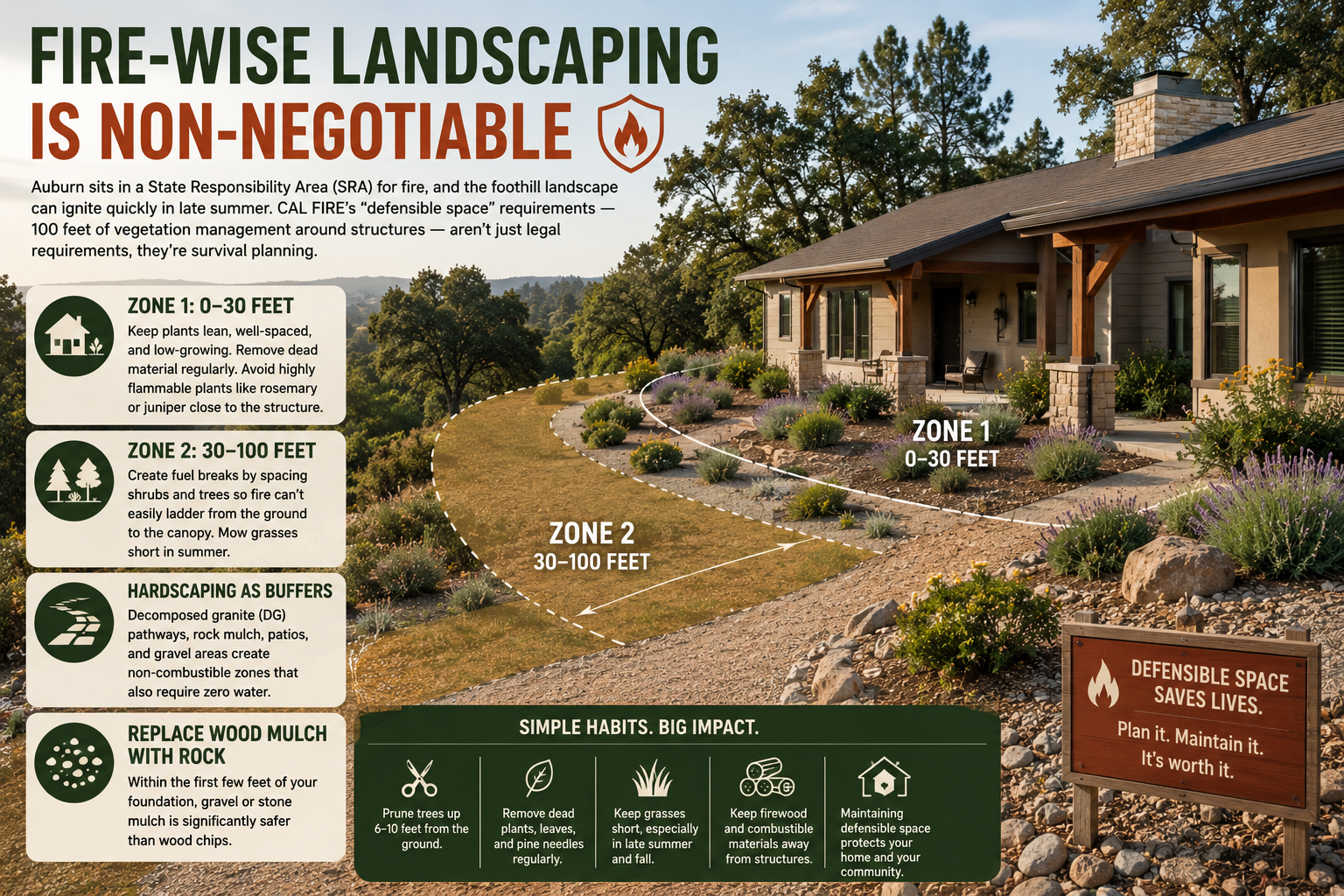
Auburn sits in a State Responsibility Area (SRA) for fire, and the foothill landscape can ignite quickly in late summer. CAL FIRE's "defensible space" requirements — 100 feet of vegetation management around structures — aren't just legal requirements, they're survival planning.
Practical fire-wise landscaping principles for Auburn:
Zone 1 (0–30 feet from the home): Keep plants lean, well-spaced, and low-growing. Remove dead material regularly. Avoid highly flammable plants like rosemary or juniper close to the structure.
Zone 2 (30–100 feet): Create fuel breaks by spacing shrubs and trees so fire can't easily ladder from the ground to the canopy. Mow grasses short in summer.
Hardscaping as buffers: Decomposed granite (DG) pathways, rock mulch, patios, and gravel areas create non-combustible zones that also require zero water.
Replace wood mulch with rock: Within the first few feet of your foundation, gravel or stone mulch is significantly safer than wood chips.
Work With the Deer (and Other Wildlife)
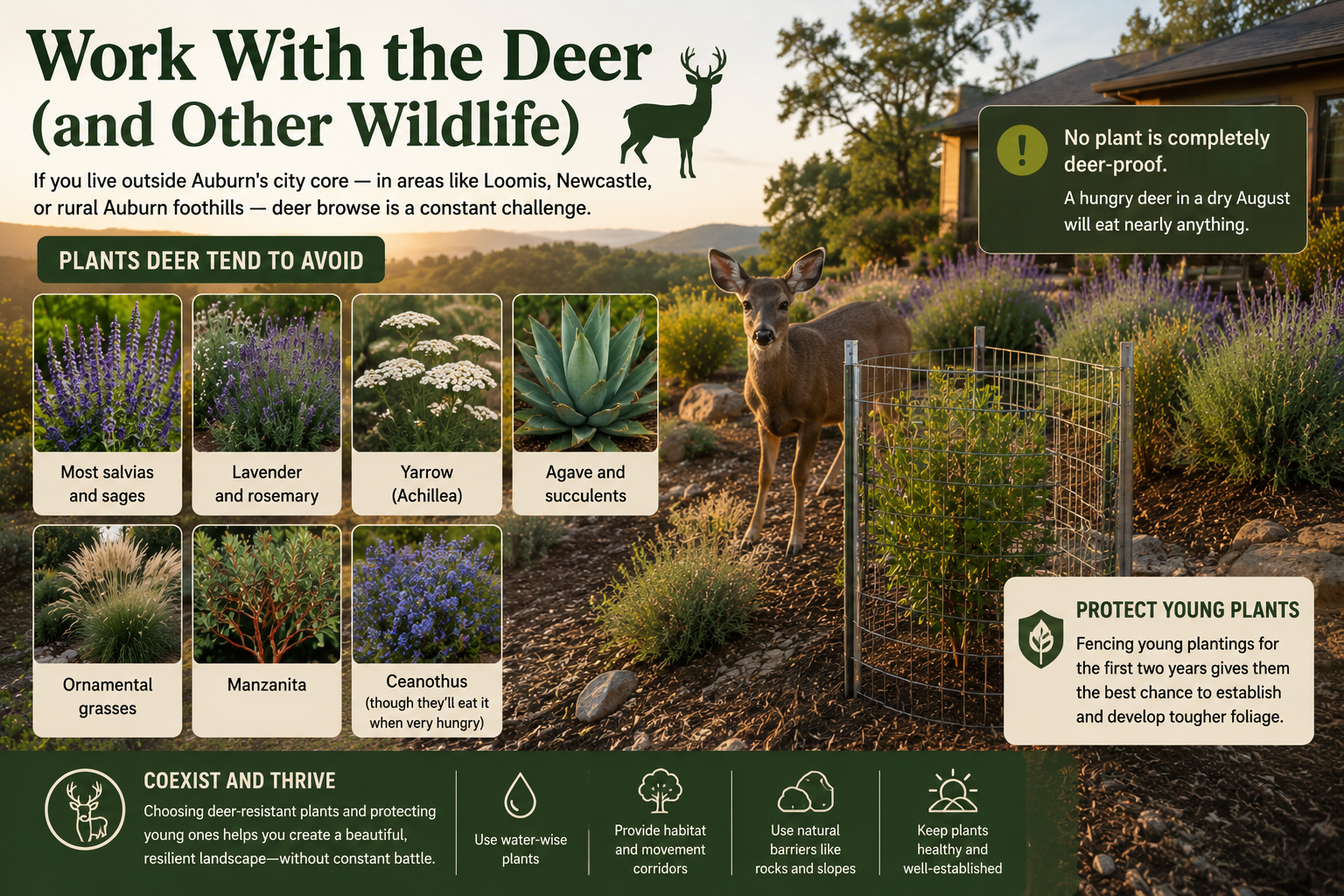
If you live outside Auburn's city core — in areas like Loomis, Newcastle, or rural Auburn foothills — deer browse is a constant challenge. Some plants they tend to avoid:
Most salvias and sages
Lavender and rosemary
Yarrow (Achillea)
Agave and succulents
Ornamental grasses
Manzanita
Ceanothus (though they'll eat it when very hungry)
That said, no plant is completely deer-proof. A hungry deer in a dry August will eat nearly anything. Fencing young plantings for the first two years gives them the best chance to establish and develop tougher foliage.
Hardscaping Ideas That Work in Auburn
Auburn's heat and dramatic terrain make hardscaping both practical and attractive. Consider:
Decomposed granite pathways and patios — DG is inexpensive, locally sourced, permeable, and looks right at home in the foothills aesthetic. Stabilized DG (with a binder mixed in) holds up better to foot traffic.
Dry-stacked or mortared stone walls — Perfect for terracing sloped lots and using granite that often comes out of the ground during excavation.
Boulder accents — Rather than fighting Auburn's rocky terrain, embrace it. Large boulders integrated into a slope look natural and eliminate erosion.
Covered patios and pergolas — With summer temperatures regularly exceeding 100°F, shade structures are as essential as any plant. Wisteria or Lady Banks rose over a pergola creates incredible ambiance while providing relief from the sun.
The Bottom Line
Great landscaping in Auburn means working with the foothills rather than against it. Embrace the dry summers, the rocky soil, the fire risk, and the wildlife — and plant accordingly. The reward is a yard that's beautiful, low-maintenance, fire-smart, and genuinely in harmony with one of California's most scenic regions.
The oaks have been doing it for centuries. Take their cue.
